A year ago I signed up for the Icelandic Rescue Team, a decision that ended up being one of the better ones I have made in recent years. The rescue team is a large group of volunteers with the mission of helping people in dangerous and difficult situations, often where the police, paramedics, and fire department can’t. These situations can be quite diverse, for example helping people who get lost or injured in the mountains or at sea. To become a qualified member of this team you must finish a 2-year training program, and I just finished my first year.
When I started my training, I thought I would learn all kinds of things about mountaineering, first aid, climbing, sailing, navigation, and other such things that I connected with adventures. What I didn’t realize is how much I would learn about teamwork and leadership. One of my most memorable experiences from my first year of training is also the experience that taught me a great lesson in leadership, and I would like to share that story and what I learned here with you.
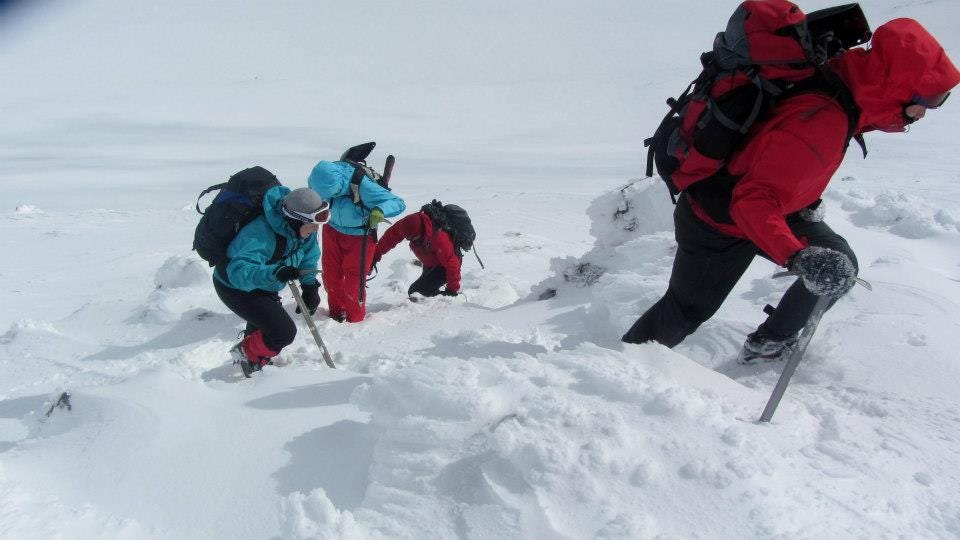
The story begins at the end of the winter when it was time for the rookies (including me) to put into action what we had learnt over the winter. We were to spend the weekend up in the mountains, where we had to reach all sorts of posts from GPS coordinates, and at each one, we had to resolve some sort of obstacle such as helping an injured man, answering questions, rappelling down the mountainside, finding a lost person, etc. I was working in a group of two other rookies, and we were dropped off on Friday evening a few hours’ hike from where the games would begin the morning after. So, the first evening we hiked about 2 hours, pitched our tent in the snow, and everything went without a hitch.
The day after we woke up, packed our stuff, and started walking. There was heavy wet snow over everything that made our travels a bit slower than we had expected, but the weather was not too bad, so it was fine. After having walked for 11 hours in this heavy snow, one of our group members had to leave, which left only the two of us, but we were determined to continue and finish the mission. So, even though we had only rested for a few minutes at a time to eat and were about 2 hours behind schedule, we continued, tired and exhausted. Soon the weather started to get worse, and we decided that we would only do one more post and then head to the cabin where all the other teams were waiting.
After finishing the post, the weather started getting much worse, and we had a hard time seeing what was in front of us. When we were getting closer to the cabin and all that was standing in our way was a large mountain and about 1 km (0.6 miles) of hiking, we stopped being able to see anything. The weather had turned so bad that all we could see was whiteness around us. At that point, we had been walking for more than 14 hours, we couldn’t see anything, and the GPS we had was acting strangely. We dropped down into the snow from complete exhaustion. I have never in my life been as completely finished, both physically and mentally, and it is not a feeling I will forget anytime soon.
So there we were, two guys out in the middle of nowhere, unable to take one more step from exhaustion, unsure of which way was the right one, and trying to keep calm and think clearly. This is the moment when I truly realized how dangerous the Icelandic nature can be and how easy it could be to die in the mountains. If we had not had the right equipment, training, and a rescue team close by, that might have been the end. We would have had to dig ourselves into the snow, spend the night there, and hope for the best.
In these extreme conditions, I learned my biggest lessons on leadership in times of trouble.
1. You can’t do everything by yourself.
When we sat there in the snow, we realized that we couldn’t get to the cabin by ourselves. We could have tried, but that might have ended in us getting into more trouble since we were not thinking clearly and were not sure of the directions. For a person like myself, who usually never asks for help with anything, it was really difficult to take up the radio and admit that we were in trouble and needed help. I felt like I should be man enough to do it myself, but it was the right decision. There was no jeep or anything that could pick us up, but they sent a fully trained rescue team member to our location to assist us.
2. Keep calm and be respectful.
The speed of the rescue person was impressive, as it only took him a few minutes to come over the mountain, even though it was only possible to see a meter or two in front of oneself due to the weather. The relief of seeing him come over the mountain was amazing, and when he approached us, he was respectful of our condition. He realized that we were exhausted and talked to us calmly and in a friendly way.
3. Take care of your team members.
Before escorting us over the mountain, he set up an emergency tent so that we could get cover from the bad weather. At first, I didn’t want to sit down and rest, I just wanted to get this over with since I wasn’t sure if I could get back up if I sat down at that point. But he insisted, and I was in no condition to disagree, so we sat down inside the tent and he gave us food, water, and chocolate to make sure we had some energy for the walk. At first, it was difficult to eat and drink, but soon I was able to eat and felt better afterward. His decision to sit us down, let us catch our breath, and recharge our batteries was completely correct in this situation.
4. Clear goals and a confident leader.
When we had rested and eaten, we got ready to continue onwards. Our rescuer, even though we still could see very little, had no doubt when he pointed towards the direction we would walk in. If he had shown any sign of uncertainty in his voice or actions, it would have been difficult to follow him properly, since I know I did not have enough energy to walk in the wrong direction or make any mistakes along the way. His clear sense of direction and confidence motivated me to continue.
5. Have a path to follow.
When we started walking, we could follow the path that our rescuer had made when he came to get us. So even though we could only see a few meters in front of us, we knew that we were going in the right direction because we could see his footsteps and we were 100% sure they led to the cabin.
After a grueling walk over the mountain, we finally reached the cabin, and we had made it. At that point, my body and mind were completely finished, and I could do nothing but lay in bed and sleep. The day after, I felt like I had been run over by a truck, but I had accomplished my mission the day before, and I had made it to the cabin thanks to the leadership shown by the Rescue Team member who saved us when we were lost.
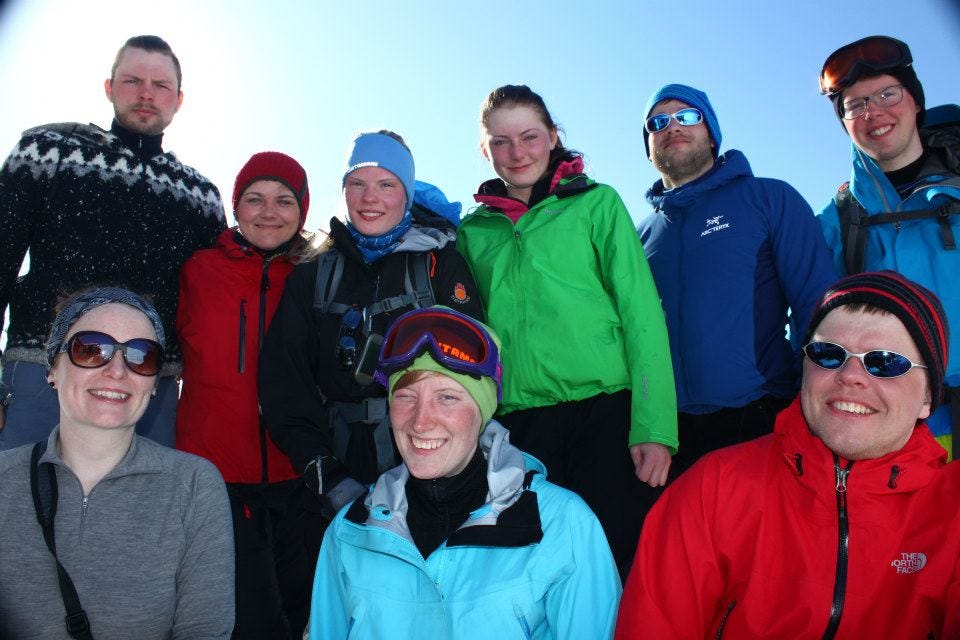
And here is a picture of all the rookies the day after.
Frumkvöðull í meira en 20 ár. Stofnandi 7 fyrirtækja og Frumkvöðlar-samfélagsins. Skrifar um ferðalagið — gott og illt.
Meira um Hauk →